


A Sunday visit to Manchester!
- Jun 16, 2025
- 5 min read
This Sunday, 15 June 2025, I had the pleasure of visiting Manchester at the invitation of the Dean of Manchester Cathedral and the Portuguese Consul.
The occasion was Portugal’s National Day, the Day of Portugal, Camões, and the Portuguese Communities, marked by the raising of the Portuguese flag in an event organised by the Consulate-General of Portugal in Manchester. Around 250 people attended, including invited guests, local city officials, the Mayor of Castelo Branco, Leopoldo Rodrigues, the Honorary Consul of Northern Ireland, myself as Mayor of Thetford, Carla Barreto, and many representatives of the Portuguese community living within the consular area.
The connection between Portugal and Manchester Cathedral dates back to 2017, when the Portuguese artist and architect Cristina Rodrigues designed seven tapestries for the altars of this beautiful English cathedral, all embroidered in Castelo Branco. According to the leaflet handed out at the entrance, “in recent years, the partnership has deepened, with regular visits from mayors, university exchanges between Manchester Metropolitan University and a Polytechnic Institute in Portugal, and an artist residency for students in Manchester”.
To open the evening, Reverend Rogers Govender, the Dean of Manchester and Head of the Cathedral Chapter, was invited to the stage. He is a black South African of Indian descent and was appointed to the role in 2005, becoming the first black Dean of Manchester Cathedral. He spoke of the Cathedral’s long-standing history of hospitality, diversity, and multicultural ties, welcoming the guests and highlighting the presence of the Mayor of Castelo Branco, Leopoldo Rodrigues, and the Consul-General of Portugal in Manchester, Duarte Bué Alves.
He thanked everyone for attending and the evening’s performances began with a solo dance by Lucy Wilson-Knight, accompanied by João Luís on saxophone and clarinet, and Gema Lu Cai on piano.
SOLO DANCE TO SAXOPHONE, CLARINET AND PIANO
In the reverent silence of the space, a solitary figure stood still at the centre, bathed in soft, almost liquid light. As the saxophone began to play a warm whisper rising into the air like a secret at dusk, the dancer allowed each note to slip across her body, which responded with long, fluid movements, as though dancing with the very breath of the instrument.
There was something intimate and raw in that beginning: the gestures were not grand but deeply felt, as though every cell of her body bowed to the melody. Her hands traced patterns in the air; her feet, barely touching the ground or en pointe, carved silent paths between the beats. The saxophone wept, and the body responded like a flame swayed by the wind of breath. A dreamlike moment simply incredible.
Then entered the piano and clarinet, each taking up the narrative, the piano with its theatrical music and the dance shifted, following closely the lyrical mood. The once-restrained body expanded, moving quickly or in slow motion: pliant and expressive. There was a play between lightness and weight, between falling and rising. The music guided, but now the body also led, as though the three, piano, clarinet, and dancer, were in a soul dialogue, not merely one of form. The performance was met with prolonged applause…
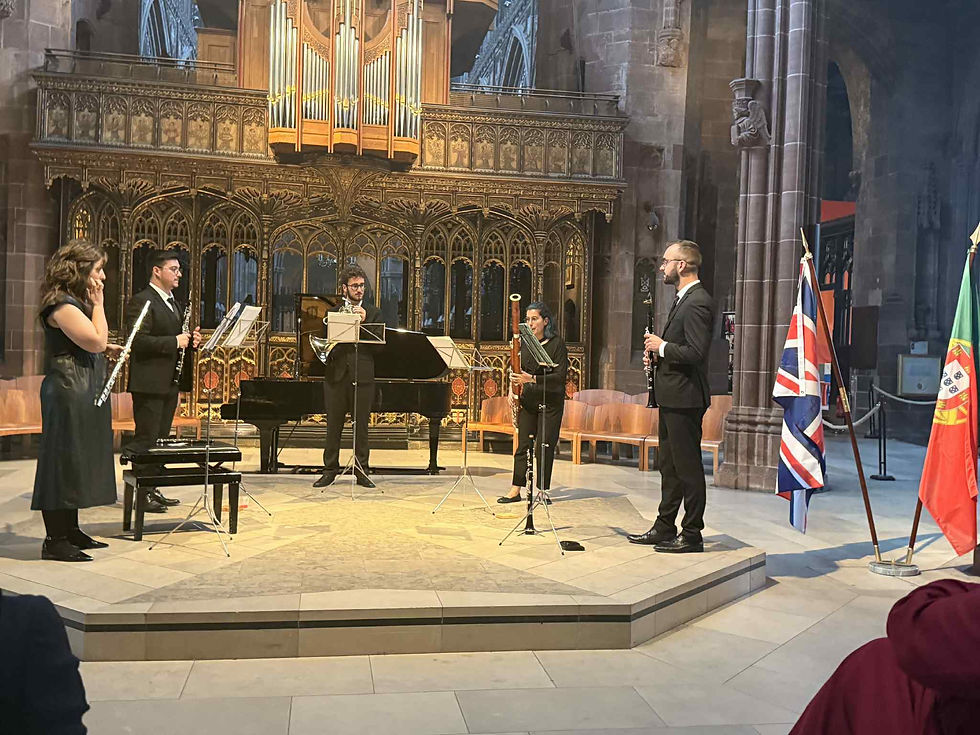
PERFORMANCE BY THE CASTELO BRANCO WIND QUINTET
The wind quintet from the Sinfonietta of Castelo Branco took to the stage with understated elegance, each musician assuming their place with the solemnity of those well-versed in a shared language. Flute, oboe, clarinet, bassoon, and horn wove a seamless dialogue, revealing a rare balance between individual voice and ensemble cohesion. The flute sparkled with airy lightness, the oboe sang with penetrating tone, the clarinet wound expressively, the bassoon grounded the group with earthy depth, and the horn united the timbres with velvety nobility. Their attentive, almost telepathic listening created a sonic fabric that breathed with ease and precision. The repertoire unfolded like a well-mapped journey.
Sometimes classical, at other times contemporary, yet always marked by clear intent and elegant execution. In fast passages, articulation was crisp, almost dance-like; in lyrical moments, expressiveness emerged with subtle warmth that enveloped rather than imposed. It was a performance where virtuosity served the music rather than showcasing individual flair marked by poetic restraint, turning the silences between pieces into a vital part of the experience. One left with the sense of having witnessed not just a concert, but a sensitive meeting of sound, space, and listening. An evening well deserving of the extended applause it received.
DESCRIPTION OF THE CATHEDRAL INTERIOR
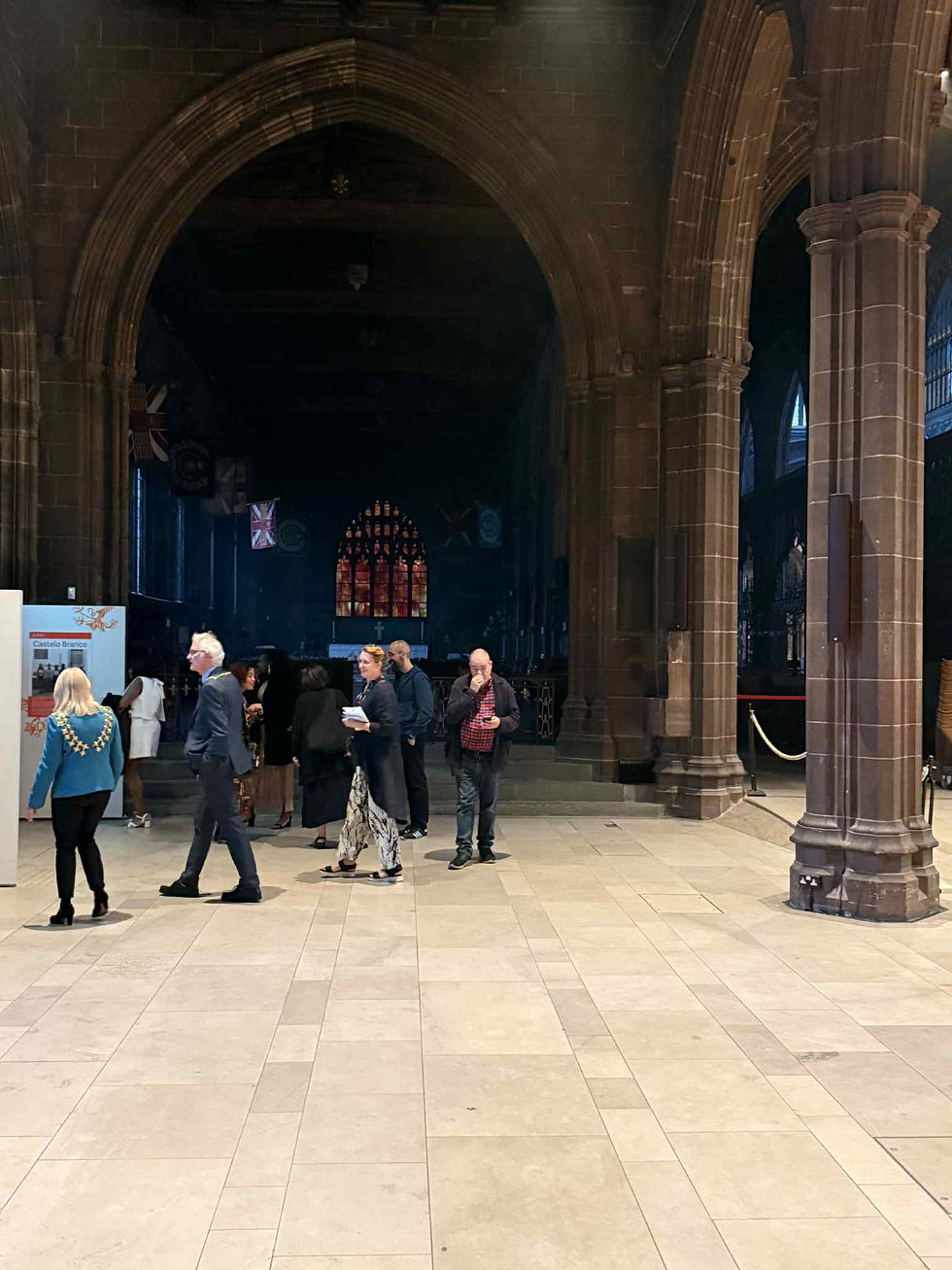
Upon entering the cathedral, one is immediately struck by the soaring ceilings with their magnificent perpendicular-style vaults, supported by ornate stone pillars. Light streams through stained glass windows, many of them restored after the Second World War, casting soft, mystical tones across the stone floor and columns, creating an almost ethereal atmosphere.
Experts explain that “during musical events, the space is transformed with stage lighting that highlights the Gothic architecture with modern touches: coloured beams of light are projected onto the ceiling’s ribs and window details, creating a dramatic interplay of shadow and sound that enhances the natural acoustics of the central nave”.
We were told the traditional wooden pews can be removed or rearranged depending on the event. A modest stage is usually installed in place of the altar or in front of the choir, so as not to compromise the sacred character of the space. The cathedral’s acoustics are exceptional, delivering clear, resonant sound, ideal for both classical and contemporary performances.
Historical elements such as the intricately carved wooden choir stalls and sculpted coats of arms remain a solemn backdrop, contrasting with modern sound and lighting systems used for events. This contrast creates a unique atmosphere, a dialogue between spiritual heritage and artistic present.
The inner chapel is nothing short of divine, preserved over many centuries. Stepping inside feels like entering a distinct and solemn world, where darker hues contrast with Cristina Rodrigues’s tapestries, a Portuguese touch seamlessly woven into the ancient architecture of the temple. It is an essential visit for anyone travelling to Manchester!
The event also marked the end of Consul Duarte Bué Alves’s term in Manchester. The city spared no effort in showing appreciation for his work across Northern Ireland, Scotland, the North of England, and Wales. As a gesture of recognition, the Portuguese flag was flown atop the cathedral for three days. He has been a true diplomat, engaging with mayors, chambers of commerce, universities, religious institutions, and more. I am proud to call him a friend.
This visit was also a valuable opportunity to strengthen ties with northern regions and to promote Thetford among the mayors of Greater Manchester and the Lord Mayor of Manchester.
After exchanging ideas and contacts, we enjoyed the vibrant setting of one of the UK’s largest cathedrals, which boasts the widest nave. The evening was filled with a charming spectacle of ballet, piano, and a young wind quintet, whose music enriched by the cathedral’s perfect acoustics transported us all.
Representing our town in such a prestigious setting was an honour. It was a moment to highlight Thetford’s potential, discuss European private investment, and champion our local businesses.
I hope to make the people of Thetford proud by raising awareness of our town’s true potential and attracting visitors to our historical gem. Stay tuned to our website and social media channels for updates on our next event!






Comments